
L1 · Why
A Life Area
The five areas of your life: Wellness, Relationships, Prosperity, Purpose and Creative Flow. Each carries the weight you give it.
Master Your Flow · the method
Dynalope asks first whether something belongs in your life at all, then plans what remains around the two resources that actually run out: time and energy.
The Golden Circle · The Flow Loop · The review ladder · Time and energy together
Philosophy
Sustained peak performance is a byproduct of a life in balance, not the other way round.
The dominant idea in productivity is to compress more work into the time you have. Dynalope starts somewhere else. Not everything deserves doing, and you have a finite, fluctuating capacity to do it well. You can only achieve what you have time for, and only achieve it well when you have the energy.
So the method runs in one direction. Purpose decides what belongs in your life. Time decides what fits in the day. Energy decides how that day is shaped. Master your flow, and performance follows on its own.
Underneath it all is one idea: self-leadership. You are not managed by an app, a manager or a scoreboard. You lead your own life, from your own why, one day at a time. What that life is finally for is not output. It is warmth, belonging, a sense of contribution, and the plain freedom to live a life that is genuinely yours. Dynalope is self-leadership made daily, the individual side of a bigger idea: organisational development through self-leadership.
The Golden Circle
Your whole life sits on one editable circle, in three levels. Anything that cannot connect up the circle to a why is not deprioritised. It is deleted.
L1 · Why
The five areas of your life: Wellness, Relationships, Prosperity, Purpose and Creative Flow. Each carries the weight you give it.
L2 · How
The parts inside an area, such as physical health, your primary relationship, or business and career.
L3 · What and who
A concrete person, role or thing you actually tend. Every task, habit and project in Dynalope hangs on one.
The mirror shows each area’s real fill against the weight you gave it. You see where your life is actually going, not where you meant it to go, and you can adjust before the gap grows.
An Object is not a folder to fill. It is something you tend, and there are only three ways you tend it. So a why always lands on something real to hold and to do.
How you mean to show up: “be fully present with my daughter”, “lead without fear”. A standing statement of intent, not a task to tick off, and it colours everything the Object touches.
The small, repeated actions that keep the Object alive between milestones, anchored to a trigger and held to a forgiving weekly target.
The finite pieces of work with a clear “done”, each one traceable straight back up to the why it serves.
The five L1 areas, each opened into the Components most lives are actually built from.
Physical health and fitness · mental and emotional health · spiritual and personal growth.
Your primary relationship · family · social life and community.
Business and career · financial freedom.
Contribution and fulfilment: the work that means something beyond you.
Adventure and exploration · creative expression.
The same shape, why, then how, then what and who, scales past a single life. An organisation runs on the very same circle: business areas, their components, and the people and roles who carry them. One model, two scales. Dynalope is it made daily for you; Hisland brings the same model to organisations as a consultancy.
Why change sticks
Most attempts to change a life start at the bottom: a new app, a tidier desk, a stricter schedule. They rarely hold, because they leave the deeper levels untouched. Robert Dilts’ logical levels explain why. A life is a stack, and a change only lasts when it is rooted above the level it is trying to fix.
So Dynalope works the stack top-down: purpose and identity first, behaviour and environment last. That is what self-leadership means here. You lead yourself from your why, and the habits and tools follow. Change you choose from the top holds. Change imposed from the outside does not.
Robert Dilts’ logical levels, worked top-down: why first.
Planning a project
A project in Dynalope always belongs to something concrete, an Object in your life, and through it to the area that Object serves. Before anything gets scheduled, the plan answers two questions in order: why this matters, and what it will look like when it is actually done.
Only once that picture is clear does the project break down into next actions, the small, concrete steps that show up in your day. You never work from a vague ambition. You work from the one thing in front of you, always traceable back up the circle to the why it belongs to.
The operating rhythm
Purpose sets the direction; a steady cadence keeps it honest. You plan on four nested horizons, and you run them on two tracks, because a life is more than a job.
Each horizon frames the next, so nothing you do today floats free of where you are headed.
Work and private life each get their own planning track, on the very same cadence, so neither quietly starves the other. You see them apart when you plan, and together when you live the day.
The Flow Loop
The whole method is a rhythm you can trust: from a fleeting thought to a finished day, and back again. Every surface in Dynalope, and every Dynabook page, follows it.
Drop anything into one inbox: text, voice, a photo, a file, a sketch, an email. Saved locally in under three seconds, before any sync.
A short wizard asks only what matters: is it actionable, what comes next, which part of your life it serves, how long, how much energy. Same item, from inbox to archive.
Projects that carry their purpose, habits anchored to their triggers, and a resource library kept so anything is easy to find again.
A morning check-in, an evening reflection that feels like a conversation, and reviews that open with your wins. The system sees you.
Your calendar and next actions carry you through the day. You confirm a plan; you do not invent one.
Underneath the daily loop runs a slower rhythm: receive what crosses your mind, review it deliberately, recall it months later still connected to its objective, and recycle what is done so the archive compounds instead of clutters.
The review ladder
The planner is touched in a few deliberate moments, never during the day. Each rung looks a little further ahead than the one below it, and each has a matching Dynabook template.
01
A sleep-and-energy check calibrates the day, and you confirm the plan you already made. Two minutes, then you live it.
02
A short conversation that closes the day: what happened, how it felt, what to carry forward. Nothing is scored.
03
Clear the inbox, clarify what came in, and let tomorrow’s plan settle before you stop for the day.
04
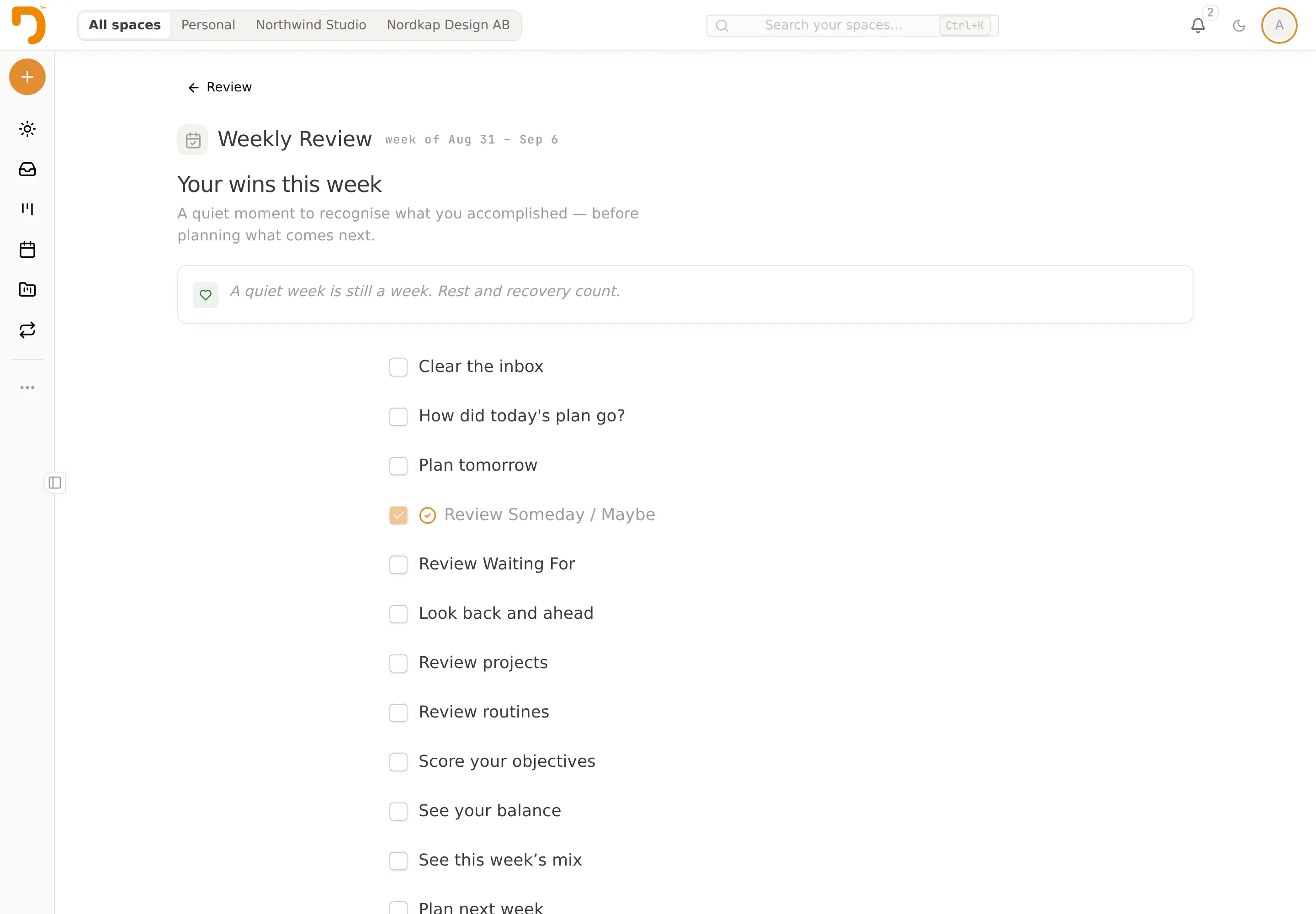
It leads with your wins. Then you shape the coming week’s days around the focus hours you actually have.
05
You look back over the month and set the theme for the quarter ahead, so the weeks have a direction to serve.
Weekly and monthly reviews always open with what went well.
Two resources most tools ignore
Calendars track time. Dynalope tracks time and energy, so the plan fits the person, not just the day.
Your available focus hours, waking time minus meetings, commitments and buffers, shown before you commit the day. A live overload warning fires while you plan, not after the day breaks.
The same picture holds whether you look at today, this week, or further out, so a commitment you make now does not quietly starve the days around it.
A quick sleep-and-energy check-in calibrates the day, and the optional Bento Box frames it as one high-, one medium- and one low-energy action, so you spend willpower where it counts and protect it where you can.
Energy is not a single bar that only runs down. It is spent and recovered in turns, across the day and the week alike. The aim is not to squeeze out every last drop but to keep that oscillation healthy, so tomorrow is not paying for today.
The Dynalope principle
A calm system is one you can trust to hold the line without holding it against you.
A gentle nudge when you are taking on too much, “want to review?”, never a block. You stay in charge; the system just tells the truth.
No red flags for a missed date, no shame for a broken run, no confetti. Miss a few days and it greets you with a two-minute reset, your habits intact under N-of-7 forgiveness.
Depth unfolds as you grow, Sprinter, Manager, Architect, so day one is calm and simple, and the richness is there when you are ready for it.
Dynalope is the method, made into an app you use every day. For you, and for your team.